
beehiiv vs Substack: Which Platform Should You Launch Your Newsletter On?
You’ve decided to start a newsletter. Smart move. Now comes the hard part: choosing where to launch it. Everyone says either beehiiv or Substack. But which one?
I’ve watched people agonize over this decision for weeks. They compare feature lists, read reviews, join Discord servers to ask strangers for advice. Most of this is wasted time.
The real question isn’t which platform has better features. Both are excellent. The real question is: what kind of newsletter are you building?
Let me save you three weeks of research. I spent a month analyzing pricing, testing both platforms, and tracking what actually happens to creators who choose each one. Here’s what I learned.
The One Thing That Actually Matters
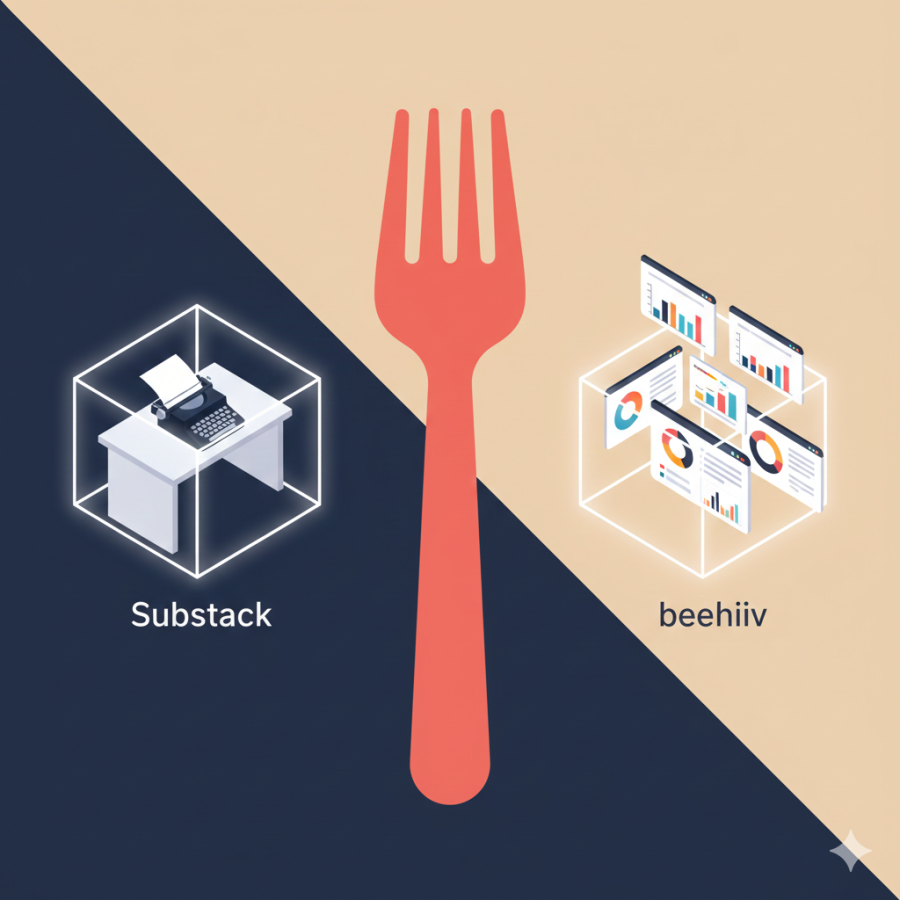
Substack is built for writers who want to write. beehiiv is built for creators who want to build a business.
That sentence will tell you which platform to choose faster than anything else. But let me show you why.
How Much Each Platform Really Costs
Substack says it’s free. beehiiv has a free plan. Both statements are technically true. Both are also misleading.
| Subscribers | Substack Cost | beehiiv Cost |
|---|---|---|
| 1,000 (free) | $0 | $0 |
| 2,500 (free) | $0 | $0 |
| 5,000 (paid) | $0 | $89/month |
| 10,000 (paid) | $0 | $109/month |
Look at that table and you might think Substack wins easily. Free forever. No subscriber limits. What’s not to love?
Here’s what the table doesn’t show you.
What Substack Actually Costs
Substack is free if you never charge for your newsletter. The moment you turn on paid subscriptions, Substack takes 10% of everything you make. Plus Stripe takes another 2.9% plus 30 cents per transaction.
Let’s say your newsletter grows. You have 5,000 subscribers. You charge $10 a month for a paid tier. You convert 5% of your free readers to paid subscribers. That’s 250 paying customers. You’re making $30,000 a year.
Substack’s cut: $3,000 a year.
beehiiv’s cut at that same scale on their Scale plan: $1,068 a year. And they take zero percent of your subscription revenue.
The “free” platform is now costing you $2,000 more per year.
What beehiiv Actually Costs
beehiiv’s free plan covers up to 2,500 subscribers. That’s genuinely generous. Most newsletters never get past 1,000 subscribers. You can write for years before hitting that limit.
When you do need to upgrade, the pricing is straightforward:
- Scale plan: $49/month (up to 10,000 subscribers)
- Max plan: $99/month (up to 100,000 subscribers)
- No revenue sharing. Ever.
The pricing goes up as you grow, yes. But it’s predictable. You know what you’ll pay. And if you monetize, you keep everything except payment processing fees.
Features That Actually Matter
Both platforms will let you write and send emails. Both have mobile apps. Both have analytics. The features that actually differentiate them are the ones tied to making money.
Substack’s Monetization: Simple But Limited
Substack does one thing brilliantly: paid subscriptions. You flip a switch, set your price, and you’re done. The simplicity is the entire point.
What you get:
- Paid subscriptions (Substack takes 10%)
- Free trial functionality
- Founding member pricing
- Basic subscriber management
What you don’t get:
- An ad network
- Sponsorship management tools
- Referral programs
- A/B testing
- Advanced segmentation
- Custom domains (you’re stuck with yourname.substack.com)
Substack made a bet: writers want to write, not run a media business. For many writers, this is exactly right. For others, it’s suffocating.
beehiiv’s Monetization: Built for Revenue
beehiiv assumes you want to make money and gives you every tool to do it:
- Paid subscriptions with 0% platform fee (you only pay Stripe)
- Built-in ad network that connects you with sponsors
- Boosts referral marketplace where you can cross-promote with other newsletters and get paid for it
- Recommendation engine to grow through other creators
- Premium polls and surveys to engage subscribers
- Website builder (via Typedream acquisition) included
The beehiiv ad network is particularly interesting. Once you have 10,000 subscribers, you can join. They match you with advertisers. You don’t have to cold email brands or negotiate rates. The network handles it.
Some beehiiv creators make more from ads and referrals than they do from paid subscriptions.
The Hidden Cost of Substack’s Simplicity
Here’s what happened to my friend Alex. He launched on Substack in 2023. Loved the simplicity. Grew to 8,000 subscribers writing about design. Started a paid tier at $8/month. Got 400 paying subscribers. Making $38,400 a year.
Substack’s annual take: $3,840.
Then he talked to another creator who mentioned they were making an extra $2,000 a month from the beehiiv ad network with a similar audience size. Alex didn’t have access to that. Substack doesn’t have an ad network.
He wanted to add a referral program to accelerate growth. Substack doesn’t have that either.
He wanted to A/B test his subject lines. Not available.
The platform that seemed simple when he started now felt limiting. Switching platforms with 8,000 subscribers is painful but doable. Switching with 50,000 subscribers is a nightmare.
This is the hidden cost of Substack’s simplicity. It’s perfect until it isn’t. And by the time you realize it isn’t, you’re trapped.
The Hidden Cost of beehiiv’s Complexity
beehiiv has the opposite problem. It gives you so many features that it can feel overwhelming.
When you log into beehiiv for the first time, you see: campaigns, posts, automations, segments, referrals, ads, boosts, 3D analytics, website builder, API access, and about fifteen other things.
For someone who just wants to write and hit send, this is too much. The interface assumes you’re thinking about conversion funnels and monetization strategy. If you’re not, it feels like driving a Formula 1 car to the grocery store.
Substack gives you a blank page and a send button. That’s it. For many writers, this is freedom, not limitation.
Who Each Platform Is Actually Built For
Choose Substack if you are:
You care about the craft. You want a platform that gets out of your way. You’re okay making less money if it means spending more time writing.
You’re not interested in ads, sponsorships, or building a complex revenue stack. You want one simple business model: charge readers directly.
You don’t want to learn new tools or think about conversion rates. You want to write in a box and click send. Substack will never overwhelm you.
You have no idea if this will work. You don’t want to commit to monthly fees. Substack lets you experiment for free until you know what you’re doing.
Choose beehiiv if you are:
You see your newsletter as a business asset. You want multiple revenue streams. You’re comfortable learning new tools if they help you make money.
You have big ambitions. You want the infrastructure to support growth. You need features that help newsletters become real businesses.
You’d rather pay a predictable monthly fee than give away 10% of revenue forever. You understand that beehiiv’s $49-$109/month is cheaper than Substack’s percentage once you monetize.
You want sponsorships, affiliate income, referral revenue, and paid subscriptions. You see the value in the ad network and Boosts marketplace.
The Migration Question
Some people ask: can I start on Substack and move to beehiiv later?
Yes. beehiiv built a Substack importer specifically for this. They even have a guide walking you through it. They want Substack’s users.
But migration is painful. You have to:
- Export your subscriber list
- Import it into beehiiv
- Rebuild your automations
- Migrate your paid subscribers (requires manual coordination)
- Redirect your old Substack URL
- Re-educate your audience about the new platform
You’ll lose some subscribers in the transition. Maybe 5%, maybe 10%. The bigger your list, the harder the migration.
Can you start on beehiiv and move to Substack later? Technically yes. But nobody does this. Substack is almost always the starting point, not the destination.
Price Stability and Trust
Substack has never changed its pricing. 10% since day one in 2017. This is worth something. You know what the deal is.
beehiiv restructured its pricing in April 2024. They made it cheaper for small users (free up to 2,500 instead of free up to 1,000), but they also introduced usage-based pricing that can get expensive at scale.
The CEO publicly said they “drastically undercharged for years.” That’s a signal. Expect prices to go up. They’re a venture-backed company that needs to show revenue growth.
Substack is venture-backed too, but their business model is tied to your success. They only make money when you make money. This aligns incentives.
beehiiv makes money whether you succeed or fail, as long as you pay your monthly bill.
Which model you prefer depends on your personality.
What I Would Actually Do
If I were starting a newsletter today, here’s exactly what I would do.
Starting from zero with no clear business model: Start on Substack. Use it until you either (a) hit 10,000 subscribers, or (b) want features Substack doesn’t offer. Most people never get to either point, which means Substack was the right choice.
Starting with a clear monetization plan: Go straight to beehiiv. If you know you want sponsorships, ads, referral revenue, and paid subscriptions, why waste time on a platform that only supports one of those four?
Already on Substack with 5,000+ subscribers and making money: Do the math. Calculate what you’re paying Substack in percentage fees versus what beehiiv would cost in monthly fees. If beehiiv is cheaper and you want the extra features, migrate. If Substack is cheaper or you don’t care about the features, stay.
Already on Substack but not making money yet: Stay put. You have nothing to lose from Substack’s 10% because 10% of zero is zero. Focus on growth. Revisit this decision when you monetize.
The Real Answer
Most people overthink this decision.
The platform doesn’t matter nearly as much as what you write. A great writer on Substack will build a bigger audience than a mediocre writer on beehiiv with all the growth tools.
But here’s the thing: if you’re the kind of person who’s going to be disciplined about monetization, growth tactics, and treating your newsletter like a business, beehiiv will make you more money. The tools matter when you use them.
If you’re the kind of person who wants to focus on writing and is happy with a simpler, cleaner business model, Substack will make you happier. Peace of mind has value.
The mistake is choosing the wrong platform for your personality. Don’t pick beehiiv because you think you should care about conversion funnels when you actually don’t. Don’t pick Substack because it’s simple when you’re secretly itching to optimize revenue streams.
Choose the platform that matches how you actually want to spend your time.
Everything else is details.